Approach
Listening to variation as both evidence and expression.
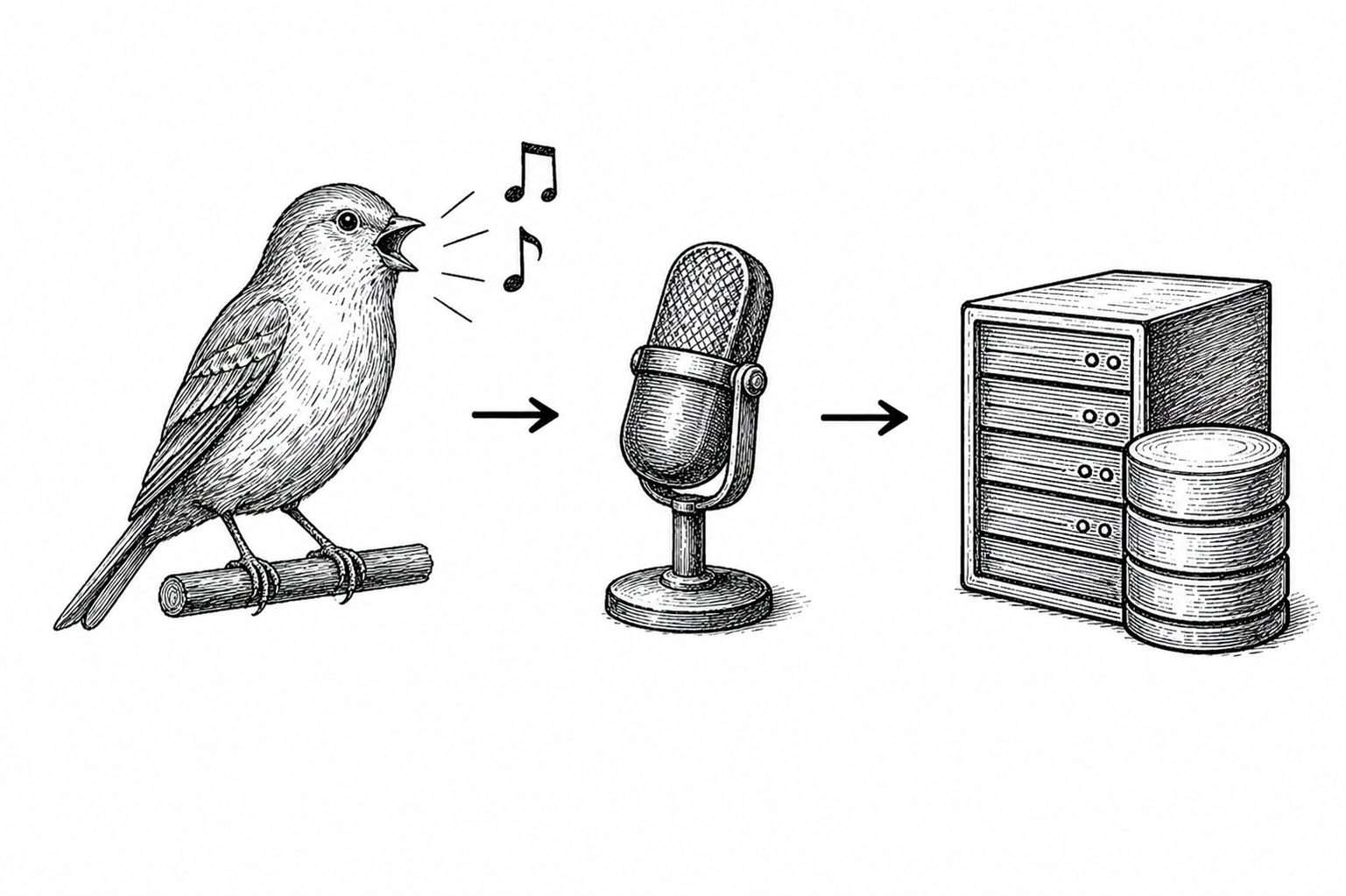
Canary songs are learned and constantly changing. No two birds sound exactly the same, and even one bird's song can shift through routine, age, environment, and daily conditions.
The archive treats each contribution in two ways at once: as data, a measurable acoustic pattern that can be compared and revisited; and as expression, a living sound situated in a particular home, body, and moment.
Gathered across homes and contexts, these recordings begin to describe a wider field of repetition, difference, influence, and memory in domesticated birdsong.
Method
A simple distributed collection process.
The project is built through modest, practical contributions: a clear recording, a little contextual information, and permission to publish the file as part of the open archive.
- Participants submit recordings made with a Raspberry Pi recorder, phone, or handheld recording device.
- Each recording is accompanied by basic context such as location, time, and recording conditions.
- Audio files are organized, preserved, and published for research and creative reuse.
Artistic use
Birdsong as material.
The recordings can become material for sound-based work, generative or algorithmic composition, listening experiments, and visual interpretations of acoustic pattern.
Data & privacy
Open data, transparent practices.
All recordings in this archive are contributed under the CC BY-NC 4.0 license and remain permanently available as open data. For full details on what is collected, how recordings are licensed, and your rights as a contributor, see the privacy policy.
Dataset snapshots
Monthly manifests for direct download.
The latest public manifest is 2026-07, with 3,417 recordings and 15 hours of audio.
The manifest is a JSON index of the public archive. Each entry describes one recording with the contributor username, bird and device identifiers, recording date, duration, location metadata, and links to the audio file, sidecar JSON, and spectrogram when available.
- manifest.json is best for scripts, filtering, and direct file downloads.
- metadata.csv is best for spreadsheets and quick comparison.
- For automated downloads, use the
urls.wav,urls.json, orurls.pngfields.
Download the manifest, filter the entries you need, then fetch each file from its URL field. A simple script can loop through urls.wav to download the audio files and use the metadata fields to name or organize them.